
Elizabeth Cady Stanton
A leader in suffrage and legal equality for women.
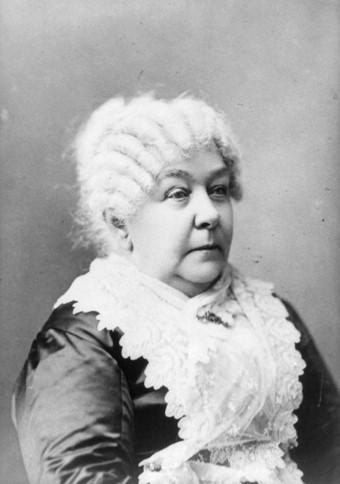
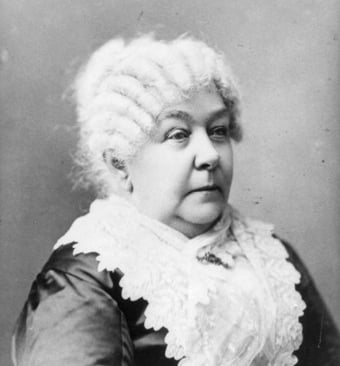
Elizabeth Cady Stanton (1815 - 1902)
"The best protection any woman can have… is courage."
A Rebel with a Cause
Imagine growing up in a big brick house in a small town in upstate New York in the early 1800s—a time when girls were expected to marry young, manage a household, and stay out of politics. Now imagine being a girl who refuses to accept that future. That girl was Elizabeth Cady Stanton.
She would grow up to become one of the boldest voices in the fight for women’s rights in the United States. She helped organize the first women’s rights convention in American history. She demanded the right to vote when most people—men and women alike—thought the idea was outrageous. She challenged laws, churches, and traditions. And she did it with sharp intelligence, fierce confidence, and a pen that could spark a revolution.
This is her story.
Biography
Elizabeth Cady was born on November 12, 1815, in Johnstown, New York. Her father, Daniel Cady, was a respected judge and lawyer. Her mother, Margaret Livingston Cady, came from a prominent family. Elizabeth grew up surrounded by books, legal discussions, and political debates. But there was one problem: the world she lived in was not built for girls like her.
As a child, Elizabeth loved reading and learning. She often listened outside her father’s office while he discussed legal cases. What she heard disturbed her. Women who were married had almost no legal rights. If a woman earned money, it belonged to her husband. If she owned property, it became her husband’s after marriage. If she divorced, she usually lost custody of her children.
Elizabeth once overheard her father explaining to a woman that the law gave her no protection from an abusive husband. When Elizabeth asked why, her father simply said, “That is the law.” That answer did not satisfy her.
Most girls in the early 1800s received very little education. But Elizabeth’s father believed in schooling, so she attended the Johnstown Academy, where she studied subjects usually reserved for boys—Latin, Greek, mathematics, and philosophy. She even won academic prizes over male classmates.
Later, she enrolled at the Troy Female Seminary (now known as the Emma Willard School), one of the few advanced schools for women at the time. There she encountered a strong curriculum—but also strict religious teachings that frightened her. After hearing intense sermons about sin and damnation, Elizabeth became deeply troubled. Eventually, she began to question not just the legal system, but also religious institutions that justified women’s inequality. The seeds of rebellion were growing.
In 1840, Elizabeth married abolitionist Henry Brewster Stanton. He was a journalist and anti-slavery activist. When they married, Elizabeth made a daring decision: she insisted on removing the word “obey” from her marriage vows. At a time when wives were legally required to submit to their husbands, this was a radical move. Soon after their wedding, the couple traveled to London for the World Anti-Slavery Convention. Henry attended as a delegate. Elizabeth went as his wife. But something happened there that would change her life.
At the 1840 World Anti-Slavery Convention in London, several American women—including the famous abolitionist Lucretia Mott—arrived as official delegates. They were refused seats. The male organizers decided that women should not participate in the proceedings. They were forced to sit behind a curtain, hidden from view. Elizabeth was furious. If even educated, accomplished women fighting slavery were denied a voice, what hope was there for ordinary women? During that convention, Elizabeth and Lucretia Mott formed a friendship and made a promise: when they returned to the United States, they would organize a convention focused entirely on women’s rights. It would take eight years—but they kept that promise.
In July 1848, Elizabeth Cady Stanton, Lucretia Mott, and a small group of reformers organized a meeting in Seneca Falls, New York. It was the first women’s rights convention in American history: the Seneca Falls Convention. About 300 people attended—men and women. At the convention, Elizabeth presented a document she had written called the “Declaration of Sentiments.” It was modeled after the Declaration of Independence, but with a powerful twist. Instead of “all men are created equal,” it declared: “All men and women are created equal.”
The document listed grievances against the government—specifically about laws that denied women property rights, educational opportunities, and the right to vote. One resolution demanded women’s suffrage—the right to vote. Many attendees thought this demand went too far. But Elizabeth stood firm.
One of the most powerful voices supporting the suffrage resolution was abolitionist and former enslaved person Frederick Douglass. Douglass argued passionately that women deserved the vote as much as Black men did. His speech helped convince the convention to adopt the suffrage resolution. The Declaration of Sentiments was signed by 68 women and 32 men. The newspapers mocked them. Critics called them “unwomanly.” Some signers were ridiculed in their communities. But a movement had begun.
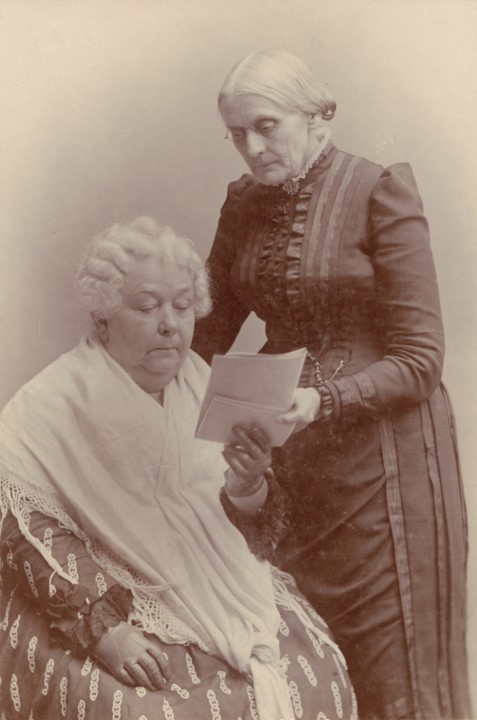
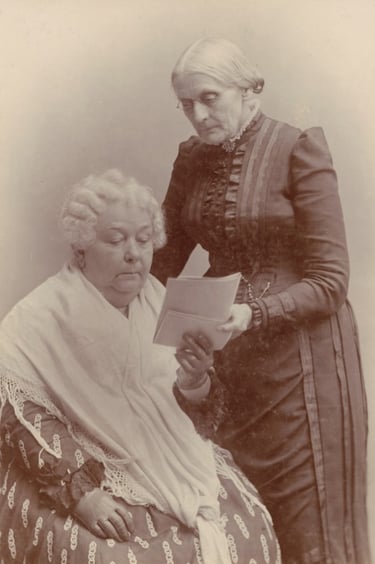
In 1851, Elizabeth met another reformer who would become her closest collaborator: Susan B. Anthony. Anthony was unmarried, practical, and tireless. Elizabeth was married, raising seven children, and brilliant with words. Together, they made an unstoppable team. Elizabeth wrote speeches and articles. Susan traveled across the country delivering them. They fought for married women’s property rights. They advocated for equal pay. They pushed for expanded educational opportunities. And always, they returned to the central demand: the vote.
BIBLIOGRAPHY
DuBois, Ellen Carol. Elizabeth Cady Stanton: Feminist as Thinker. New York University Press, 2008.
Ginzberg, Lori D. Elizabeth Cady Stanton: An American Life. Hill and Wang, 2009.
Griffith, Elisabeth. In Her Own Right: The Life of Elizabeth Cady Stanton. Oxford University Press, 1984.
Library of Congress. “Elizabeth Cady Stanton Papers.”
National Park Service. “Elizabeth Cady Stanton.” Women’s Rights National Historical Park.
National Women’s History Museum. “Elizabeth Cady Stanton.”
Stanton, Elizabeth Cady. Eighty Years and More: Reminiscences 1815–1897. 1898.
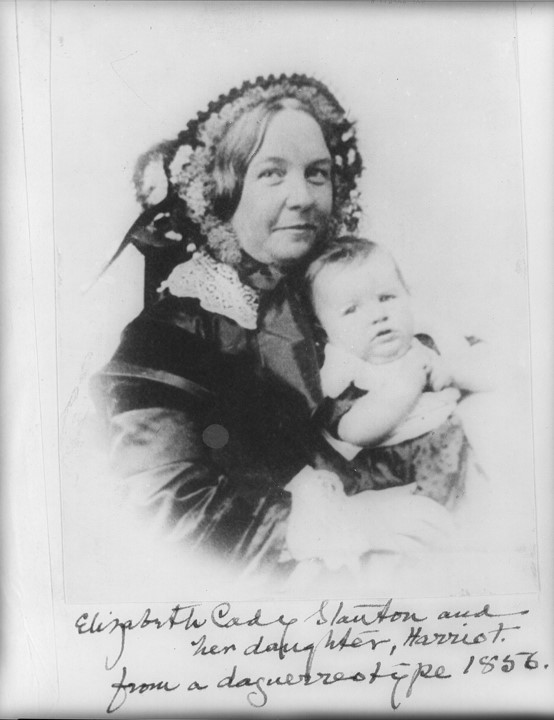
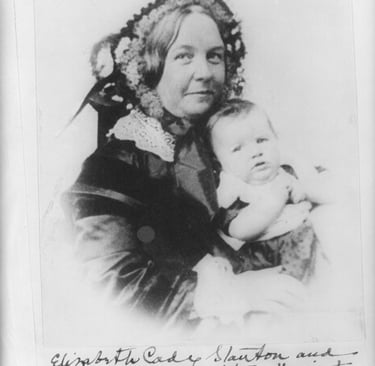
Elizabeth Cady Stanton and her daughter Harriot
Library of Congress
Elizabeth Cady Stanton and Susan B. Anthony
Library of Congress
When the Civil War began in 1861, many reformers—including Stanton and Anthony—paused their work for women’s rights to support the abolition of slavery. After the war ended, the nation debated new constitutional amendments. The 14th Amendment introduced the word “male” into the Constitution for the first time. The 15th Amendment granted Black men the right to vote—but not women. Elizabeth was deeply disappointed.
She believed suffrage should be universal—regardless of race or sex. However, tensions grew within the reform community. Some activists argued that securing voting rights for Black men was an urgent priority and that women’s suffrage could wait. The disagreement caused a split. Stanton and Anthony formed the National Woman Suffrage Association in 1869, focusing on a federal amendment for women’s suffrage. Other activists formed a separate organization that pursued a state-by-state strategy. The movement had fractured—but it continued.
Elizabeth Cady Stanton was not afraid of controversy. In addition to fighting for voting rights, she criticized religious institutions for promoting female submission. She argued for more liberal divorce laws and greater reproductive autonomy for women—ideas that shocked 19th-century society. Later in life, she helped write The Woman’s Bible, which reinterpreted biblical passages about women. Many suffragists worried that this book would hurt their cause by alienating religious supporters. Even some of her allies distanced themselves. But Elizabeth believed deeply in intellectual honesty. She refused to soften her views simply to gain popularity.
In 1890, the two rival suffrage organizations reunited to form the National American Woman Suffrage Association. Elizabeth Cady Stanton became its first president. However, by then she was older and less able to travel. The public face of the movement increasingly became Susan B. Anthony. Elizabeth died in 1902 at the age of 86. She did not live to see women gain the right to vote. That victory came in 1920 with the ratification of the Nineteenth Amendment to the United States Constitution. But without her leadership at Seneca Falls and decades of relentless advocacy, that amendment might never have passed.
Elizabeth Cady Stanton was brave, intelligent, and visionary. She challenged unjust laws and refused to accept limits placed on her because she was a woman. However, like many historical figures, she was also complex. Some of her later comments about race during the suffrage debates have been criticized as insensitive and exclusionary. Historians continue to examine her legacy with both admiration and honesty. Understanding her means recognizing both her achievements and her flaws.
Today, girls attend schools and universities in equal numbers to boys. Women vote, run for office, own property, and lead corporations. These rights were not simply given. They were demanded—persistently and courageously—by people like Elizabeth Cady Stanton. She once said: “The best protection any woman can have… is courage.” As a young girl listening outside her father’s office, she could have accepted the law as it was. Instead, she chose to challenge it. That decision changed American history.
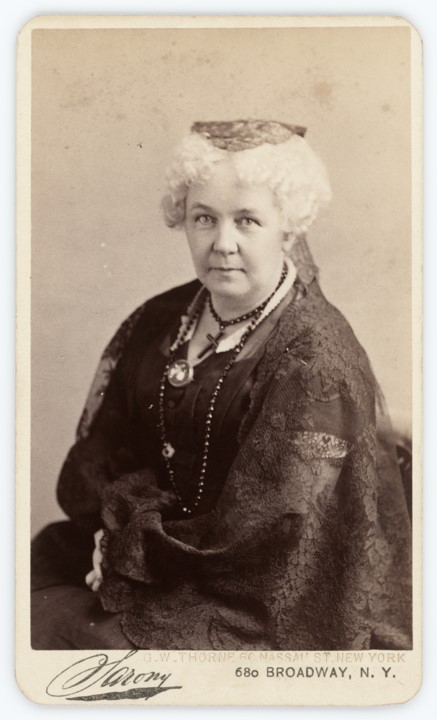
Elizabeth Cady Stanton
National Portrait Gallery (Smithsonian)
HerWorldNow.com
Learn about women's voices today
© 2026 Sarina Singhal. All rights reserved.