Fast Fashion
The fast fashion industry thrives on a gendered hierarchy, utilizing a workforce that is 80% female to maintain low costs and high speeds. This model perpetuates systemic exploitation, characterized by poverty wages, unsafe environments, and pervasive gender-based violence.
2/22/2026
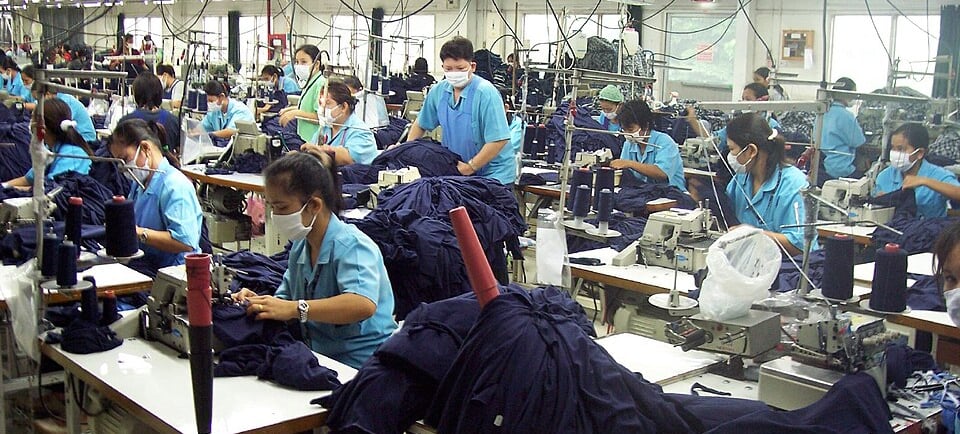
Garment factory workers in Thailand during their work hours (from Wikimedia Commons)
The Threads of Exploitation: Fast Fashion, Gendered Injustice, and the Global Movement for Reform
The global fashion industry is a behemoth of modern commerce, valued at approximately $1.5 trillion and employing over 75 million people worldwide. Yet, beneath the veneer of high-speed trends and accessible pricing lies a structural reality defined by profound inequality. The rise of "fast fashion"—a business model predicated on the rapid production of high volumes of clothing—has fundamentally reshaped global labor markets, creating a supply chain that is not only environmentally destructive but deeply gendered in its exploitation. To understand the fast fashion crisis is to understand a systemic assault on the economic, physical, and social well-being of women in the Global South. However, in response to these entrenched issues, a robust ecosystem of legislative, grassroots, and consumer-led interventions has begun to emerge, signaling a potential turning point for the industry.
The Gendered Architecture of the Garment Industry
The garment industry is one of the most female-dominated sectors in the global economy, with women making up an estimated 80% of the workforce. This demographic concentration is not accidental; it is the result of a deliberate search by multinational corporations for "docile" and "flexible" labor. In many garment-producing hubs, such as Bangladesh, Vietnam, Cambodia, and Ethiopia, societal norms often relegate women to the private sphere or lower-status roles. Global brands capitalize on these patriarchal structures, viewing young women as a workforce less likely to unionize, less likely to demand higher wages, and more likely to accept precarious working conditions.
This gendered concentration creates a "feminization of poverty" within the supply chain. While the fashion industry creates immense wealth for CEOs and shareholders—primarily in the Global North—the women at the bottom of the chain rarely earn a living wage. In Bangladesh, where the garment sector accounts for over 80% of total exports, the minimum wage for garment workers remains significantly below the cost of basic necessities like nutritious food, safe housing, and healthcare. This wage gap ensures that women remain in a cycle of subsistence, unable to accumulate savings or invest in the education of their children, thereby perpetuating intergenerational poverty.
Violence as a Tool of Production
The exploitation of women in fast fashion extends far beyond the paycheck. The industry’s demand for "ultra-fast" turnarounds creates a high-pressure environment where production quotas are often unattainable. To meet these deadlines, male supervisors frequently use verbal abuse, physical threats, and sexual harassment as management tools. A 2018 report by Human Rights Watch and various labor unions highlighted that sexual harassment is endemic in garment factories; women reported being denied bathroom breaks, being forced to work overtime without pay, and being targeted for sexual favors in exchange for contract renewals or safety from termination.
The physical safety of these women has also been historically neglected. The 2013 Rana Plaza collapse in Bangladesh, which killed over 1,100 people, remains the deadliest industrial accident in the history of the garment industry. The majority of the victims were young women. This disaster laid bare the "race to the bottom" in which brands demand the lowest possible prices from suppliers, who in turn cut corners on building safety and electrical standards to maintain their slim margins.
Environmental Degradation: A Gendered Burden
The environmental impact of fast fashion is the second-largest polluter of clean water globally, and this, too, has a gendered dimension. The textile industry relies heavily on toxic chemicals for dyeing and finishing fabrics, which are often discharged untreated into local waterways. In rural communities in the Global South, women are typically responsible for fetching water, washing clothes, and tending to subsistence crops. When rivers are poisoned by lead, mercury, and arsenic from textile runoff, it is women and children who suffer the most immediate health consequences, ranging from skin diseases to reproductive complications. Furthermore, as climate change—exacerbated by the fashion industry’s high carbon footprint—triggers droughts and floods, the resulting resource scarcity places an even heavier domestic burden on women, further limiting their time for education or political participation.
The fast fashion industry thrives on a gendered hierarchy, utilizing a workforce that is 80% female to maintain low costs and high speeds. This model perpetuates systemic exploitation, characterized by poverty wages, unsafe environments, and pervasive gender-based violence. However, the landscape is shifting from voluntary corporate pledges toward legally binding accountability. Key drivers of change include the EU’s Due Diligence Directive, the International Accord for factory safety, and grassroots victories like India’s Dindigul Agreement. By centering women's labor rights and environmental justice, these global movements are finally challenging the industry’s historic "race to the bottom."
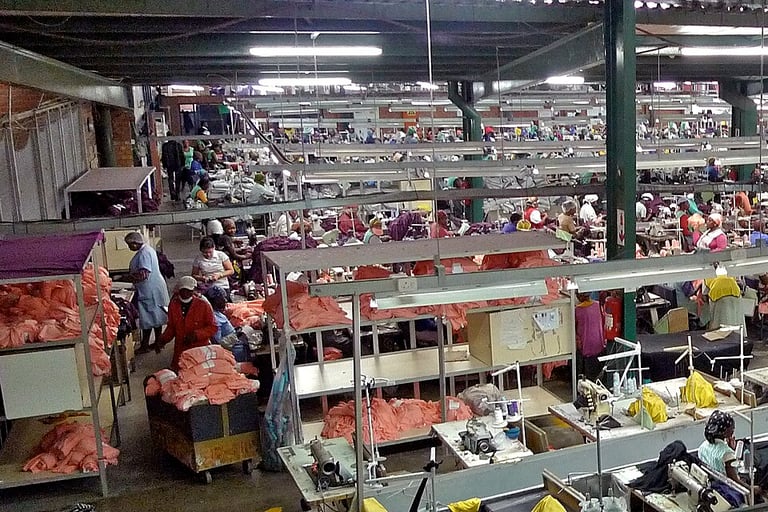
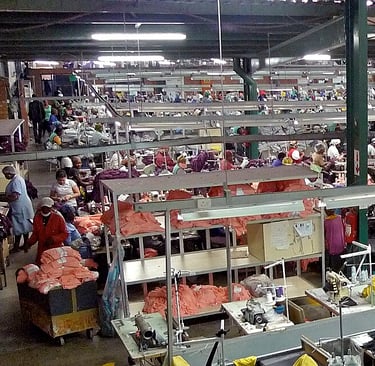
African women working in a Chinese-owned factory in Lesotho. (from Wikimedia Commons)
The Counter-Movement: From Voluntary to Binding Accountability
For decades, the fashion industry operated under a regime of "Corporate Social Responsibility" (CSR), characterized by voluntary codes of conduct and self-regulation. However, the persistence of poverty wages and factory disasters proved that voluntary measures were insufficient. Today, the movement for reform has shifted toward binding legal accountability.
One of the most significant successes in this arena is the International Accord for Health and Safety in the Textile and Garment Industry. Born out of the ashes of Rana Plaza, the Accord is a legally binding agreement between global brands and trade unions. Unlike previous voluntary audits, the Accord allows for independent inspections and requires brands to cut ties with factories that refuse to make necessary safety repairs. It has transformed the safety landscape in Bangladesh and has recently expanded to Pakistan, proving that when brands are legally liable, change happens.
In the legislative sphere, the European Union is leading the charge with the Corporate Sustainability Due Diligence Directive (CSDDD). This landmark legislation moves beyond mere reporting; it requires large companies to actively identify and mitigate human rights and environmental risks throughout their entire global supply chain. If a brand is found to have ignored forced labor or environmental poisoning in its third-tier factories, it can now face significant fines and civil litigation in European courts. Similarly, in the United States, the California Garment Worker Protection Act (SB62) has set a precedent by eliminating the "piece-rate" pay system, which previously allowed factories to pay workers based on the number of garments produced rather than an hourly wage, often resulting in pay far below the legal minimum.
The Power of Grassroots Feminist Labor Organizing
While high-level laws are crucial, the most sustainable change is driven by the women workers themselves. Feminist labor unions are increasingly challenging the "docile" stereotype. A landmark example is the Dindigul Agreement in India. Following the tragic murder of a young garment worker by a supervisor at an Eastman Exports factory, a coalition of Dalit women (the Tamil Nadu Textile and Common Labour Union) teamed up with international labor groups to force a binding agreement on the supplier and global brands like H&M. The agreement creates a shop-floor monitor system where workers can report harassment without fear of retaliation, marking a historic shift in power dynamics in the Indian garment sector.
The Consumer’s Role: Transparency as a Catalyst
Finally, the rise of the "conscious consumer" has forced a degree of transparency previously unseen in the industry. Organizations like Fashion Revolution and their "Who Made My Clothes?" campaign have utilized social media to bridge the gap between the consumer in London or New York and the garment worker in Phnom Penh. By demanding data through the Fashion Transparency Index, these movements have made it "bad for business" for brands to remain opaque about their factory lists.
Conclusion
The fast fashion crisis is a complex tapestry of economic greed, patriarchal control, and environmental neglect. For too long, the industry has treated the lives of women in the Global South as disposable inputs in a quest for infinite growth. However, the landscape is shifting. The transition from voluntary CSR to legally binding directives, the rise of powerful female-led trade unions, and the increasing demand for transparency are beginning to unravel the old structures of exploitation.
True justice in the fashion industry will not be achieved through a single "sustainable" collection or a philanthropic donation. It requires a fundamental redistribution of power and profit. It requires a world where a woman’s right to a living wage, a safe workplace, and bodily autonomy is not secondary to the speed of a trend. The momentum of the current movement suggests that while the threads of exploitation are deep, they are finally being cut.
Bibliography
Institutional and NGO Reports:
Clean Clothes Campaign (2020). Unpaid Billions: The Impact of the Pandemic on Garment Workers.
Human Rights Watch (2018). “Paying for a Bus Ticket and Cash for My Dinner”: Documentation of Sexual Harassment in the Global Garment Industry.
International Labour Organization (ILO) (2021). Gendered Impacts of COVID-19 on the Garment Sector. Geneva: ILO Publications.
The Fashion Transparency Index (2023). Annual Report on Global Brands and Retailers. Fashion Revolution.
Legal and Policy Frameworks:
European Commission (2024). Directive on Corporate Sustainability Due Diligence (CSDDD): Final Text and Implementation Guidelines.
State of California (2021). Senate Bill No. 62: The Garment Worker Protection Act.
Academic and Investigative Sources:
Anguelov, N. (2015). The Dirty Side of the Fashion Industry: Fast Fashion and Its Negative Impact on Environment and Society. CRC Press.
Asia Floor Wage Alliance (2022). The Dindigul Agreement: A Victory for Dalit Women and Global Labor Solidarity.
Brooks, A. (2019). Clothing Poverty: The Hidden World of Fast Fashion and Second-hand Clothes. Zed Books.
Hoskins, T. E. (2014). Stitched Up: The Anti-Capitalist Book of Fashion. Pluto Press.
Digital Resources and Databases:
The International Accord for Health and Safety in the Textile and Garment Industry. internationalaccord.org
Good On You. Ethical Brand Ratings and Supply Chain Analysis. goodonyou.eco
UN Women (2021). Case Study: Women in the Garment Industry and the Generation Equality Action Coalitions.
HerWorldNow.com
Learn about women's voices today
© 2026 Sarina Singhal. All rights reserved.