
Margaret Brent
A pioneer woman shaping Maryland’s early history
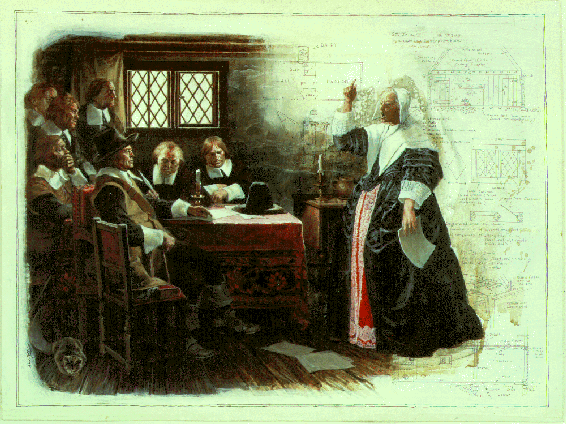
Margaret Brent (1601 – 1671)
"I've come to seek a voice in this assembly. And yet because I am a woman, forsooth I must stand idly by and not even have a voice in the framing of your laws."
Landowner · Lawyer · Suffragist · Founding Mother of Maryland
She never wore a wedding ring, never deferred to a husband, and never shrank from a courtroom. In a century when women were expected to live quietly within the boundaries drawn by fathers and then husbands, Margaret Brent drew her own. She was a landowner, a moneylender, an attorney, and ultimately the woman who saved a colony — and then, with stunning audacity, demanded the right to vote for it.
Born around 1601 in Gloucestershire, England, Margaret came into the world as one of thirteen children of Richard Brent, Lord of Admington and Lark Stoke, and his wife Elizabeth Reed. The Brents were landed Catholic gentry — educated, connected, and quietly rebellious. Though the family outwardly conformed to the Church of England, their Catholic faith simmered beneath the surface, a dangerous secret in an era of religious persecution.
Under English law, primogeniture ensured that the family's wealth passed to the eldest son. For daughters like Margaret, the path forward was narrow: marry well, or depend on the charity of brothers. But Margaret seems to have harbored a different ambition entirely — one that England's rigid hierarchies could not accommodate.
Crossing the Atlantic
The decision to emigrate was shaped by both faith and pragmatism. After Margaret's older sister Catherine openly converted to Catholicism, moved to Belgium, and became a nun — eventually rising to abbess of the English convent of Our Lady of Consolation in Cambrai — the scrutiny on the Brent family intensified. In 1638, Margaret, her sister Mary, and brothers Giles and Fulke made the crossing to the Maryland colony, arriving at St. Mary's City on November 22, 1638.
Maryland was not a random destination. The colony had been founded by their cousin Cecil Calvert, the second Lord Baltimore, as a Catholic refuge — a remarkable experiment in religious tolerance that promised Christian settlers freedom of worship regardless of denomination. For the Brents, it represented both sanctuary and opportunity.
Because of their prestigious family connections and the letters of introduction they carried from Lord Baltimore himself, the Brents received a generous welcome. Margaret and Mary, as unmarried women with servants in tow, were entitled to land grants. On October 4, 1639, Margaret became the first female landowner in Maryland's history, establishing a 70.5-acre estate with her sister that they named Sisters' Freehold, along with an adjacent 50 acres called St. Andrew's. Their initial entitlement was ultimately expanded to 800 acres per sister, and Margaret would eventually accumulate nearly 1,800 acres through her own shrewd dealings.
Feme Sole: A Woman Unto Herself
The legal concept that defined Margaret's extraordinary life was the status of feme sole — a woman unto herself. Under English common law, a married woman was legally subsumed into her husband's identity: she could not own property, enter contracts, or sue in her own name. But an unmarried woman of property occupied a different legal space entirely, with rights and responsibilities approaching those of men.
Margaret never married. In a colony where men outnumbered women by roughly six to one — creating enormous social pressure on women to wed — her continued singlehood was remarkable. Some historians, including Dr. Lois Green Carr, believe that Margaret and her sister may have taken vows of celibacy through Mary Ward's Catholic Institute in England, coming to Maryland not as nuns but as lay women committed to helping establish a Catholic settlement. Whatever the reason, the decision proved transformative. As feme sole, Margaret was free to build an empire of her own making.
And build she did. She traded in tobacco, imported indentured servants and sold their contracts to other colonists, and extended loans to new settlers looking to establish their farms and businesses. When debts went unpaid, she went to court — and she won, every time. Between 1642 and 1650 she was involved in at least 124 court cases before the Maryland Provincial Court, appearing not only on her own behalf but as an attorney for her brother Giles and various women who needed representation. She was, in all but formal title, America's first female lawyer.
Governor Leonard Calvert recognized her abilities early. In 1641, he named Margaret joint guardian with himself of seven-year-old Mary Kittamaquund, daughter of the Piscataway Tayac, or chief — a diplomatic arrangement that reflected both the trust Calvert placed in her and her standing in the colony.
Ingle's Rebellion: The Colony on the Brink
Maryland's experiment in religious tolerance was always fragile, vulnerable to the same conflicts tearing England apart. In early 1645, those conflicts came crashing onto Maryland's shores. Richard Ingle, a Protestant sea captain and ally of Virginia trader William Claiborne, led a surprise raid on St. Mary's City in the name of the English Parliament, which was then locked in civil war with King Charles I.
The attack was devastating. Ingle's men burned the Catholic chapel, plundered the homes of Catholic settlers, and seized Margaret's brother Giles along with two Jesuit priests, hauling them back to England in chains. Governor Leonard Calvert fled to Virginia. The colony's population, which had stood at perhaps 500 to 600 souls, collapsed to fewer than 100 — fewer people than had sailed on the Ark and Dove to found Maryland eleven years before.
Late in 1646, Calvert returned from Virginia with a force of mercenary soldiers and reclaimed the colony. Ingle's rebellion was suppressed. But the victory was short-lived. Leonard Calvert had pledged his own estate and his brother's Maryland holdings as security for the soldiers' wages, and before he could settle those accounts, he fell gravely ill.
On his deathbed in June 1647, Leonard Calvert made two appointments. He named Thomas Greene as his successor as governor. And he named Margaret Brent as the executrix of his estate, with a charge that would define the next year of her life and the survival of the colony itself.
"Take all, pay all."
Four words. An entire colony's fate.
Saving Maryland
The crisis Margaret inherited was severe. The mercenary soldiers who had retaken Maryland were camped at St. Mary's, hungry and unpaid. Under English law she could not sell the governor's land to meet his debts — she lacked the authority. The colony's food supply was dangerously low. And the soldiers, growing restless and angry, were on the verge of mutiny. A mutiny in Maryland in 1647 would not have been merely a local disorder — it could have ended the colony's existence and delivered the Calverts' territory to Virginia.
Margaret moved with precision and speed. First, she managed what funds remained from Calvert's estate to address his other debts. Then she turned to the harder problem: the soldiers. She could not sell land — but she needed authority that went beyond her role as executrix. Leonard Calvert had been serving as attorney-in-fact for his brother Lord Baltimore, managing Baltimore's Maryland holdings in his absence. With Calvert dead and no successor appointed, Margaret went before the Provincial Court and asked to be named Lord Baltimore's attorney in his place.
The court granted her request on January 3, 1648. It was a remarkable act — a colonial court investing a woman with the power of attorney over the proprietor's vast estate. But remarkable times called for it.
Armed with this authority, Margaret imported corn from Virginia to feed the hungry soldiers. Then, having exhausted every other option, she sold some of Lord Baltimore's cattle to meet their wages. The soldiers were paid. The mutiny was averted. Maryland survived.
The Maryland Assembly, which witnessed all of this, later wrote to Lord Baltimore in her defense:
"We do verily believe and in conscience report that it was better for the Colony's safety at that time in her hands than in any man's else in the whole Province after your brother's death, for the soldiers would never have treated any other with that civility and respect, and though they were even ready at several times to run into mutiny, yet she still pacified them..."
The Vote: A Historic Demand
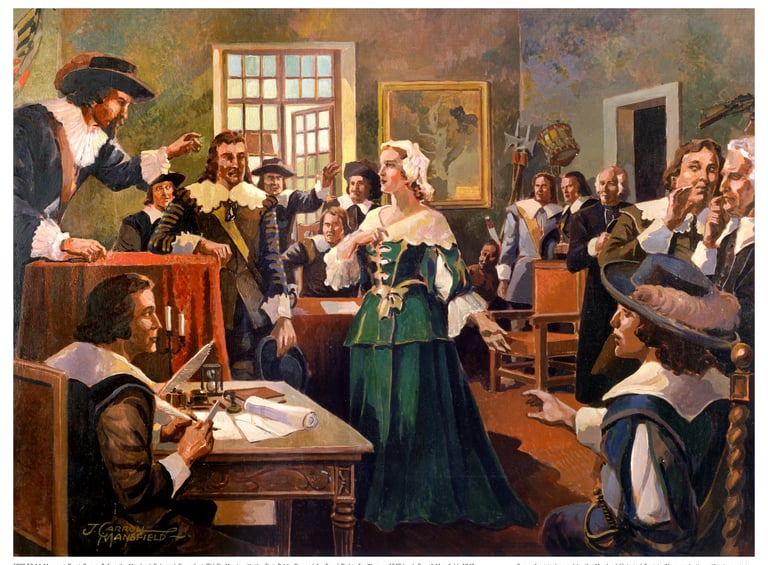
It was in this context — as Lord Baltimore's attorney, as Leonard Calvert's executrix, as the woman who had just saved the colony — that Margaret Brent walked into the Maryland General Assembly on January 21, 1648, and made history.
She requested two votes: one as a major landowner, in keeping with the Assembly's property-based representation, and one as Lord Baltimore's legal representative. Her reasons were likely both practical and principled. She may have hoped to convince the Assembly to levy a tax that would reduce her need to sell Baltimore's property without his consent. She may also have wished to put herself on record, to create a formal basis for actions she had already taken.
Whatever her reasoning, her words rang through that chamber with a clarity that has echoed across the centuries. According to records, she declared that she had come to seek a voice in the assembly, and that because she was a woman, she was expected to stand idly by without even a voice in the framing of its laws.
Governor Thomas Greene refused. The assembly was not prepared to grant such privileges to a woman. Margaret Brent did not rage or plead. She simply stated, with the measured finality of a person who understands exactly what she is doing, that she protested against all proceedings of the present assembly unless she was permitted to be present and have a vote as requested. Then she walked out.
It was the first formal request by a woman for the right to vote in American colonial history — made nearly 270 years before the Nineteenth Amendment would grant that right to all women. Whether Margaret intended it as a statement about women's rights broadly or primarily as a tactical move in the management of Baltimore's estate, the moment was without precedent. It has led generations of historians to call her North America's first suffragist.
The Price of Heroism
Lord Baltimore, managing his proprietorship from England, had no clear picture of how close his colony had come to catastrophe. What he saw, from across the Atlantic, was that a woman had sold his cattle without his permission. He launched, in the words of contemporary sources, a bitter invective against her, accusing her of wasting his estate.
The Maryland Assembly defended her. But Lord Baltimore was not persuaded. His displeasure, combined with the ascension of a new Protestant governor and the general shift in Maryland's political winds, made the colony increasingly hostile to the Brent family. Margaret, Mary, and Giles relocated to Virginia around 1650.
Margaret had already been making investments in Virginia land since 1647, with characteristic foresight. Her holdings there would eventually include tracts in what later became Alexandria, Fredericksburg, and the land on which George Washington would build Mount Vernon. She established a plantation she named, with quiet eloquence, Peace.
Peace: The Final Chapter
At Peace, Margaret continued to live as she always had — independently, purposefully, on her own terms. She and Mary remained single, two of the very few unmarried English women in the Chesapeake region. Margaret held festive annual court leets for her people, managing her estate with the same energy she had brought to Maryland's crisis.
In 1658, Mary Brent died, leaving her entire 1,000-acre estate to her sister. Margaret wrote her will in 1663 and in 1670 assigned half of her 2,000 Maryland acres to her nephew James Clifton. The remainder went to her brother Giles and his children.
Margaret Brent died at Peace in 1671, in what had become Stafford County, Virginia. Her will was admitted to probate on May 19, 1671. She left behind a legacy of property, hard-won independence, and one extraordinary moment in a colonial assembly when a woman stood up and demanded to be counted.
Legacy: A Founding Mother Reclaimed
For much of the centuries that followed, Margaret Brent's story was known primarily to specialists in colonial Maryland history. But she has steadily claimed the recognition she deserves.
In 1991, the American Bar Association's Commission on Women in the Profession established the Margaret Brent Women Lawyers of Achievement Award, honoring outstanding female attorneys who have paved the way for others. She is memorialized at Historic St. Mary's City, where a garden and a bas-relief plaque by sculptor Mary F. dePackh mark the site where she addressed the Assembly. She was named to the inaugural class of Virginia Women in History in 2000 and was among the first group of women inducted into the Maryland Women's Hall of Fame in 1985. Schools in both Maryland and Virginia bear her name. Historical markers in Virginia recognize her role in women's rights, her establishment of the first Roman Catholic settlement in Virginia, and her guardianship of Mary Kittamaquund.
She is today recognized as a Founding Mother of Maryland — not metaphorically, but literally. Without her steadiness in the winter of 1647 to 1648, the Maryland colony might well have collapsed into mutiny and been absorbed by Virginia. The experiment in religious tolerance that Lord Baltimore had launched would have ended. The particular thread of American history that runs through Maryland's founding would have been cut.
BIBLIOGRAPHY
Primary and Archival Sources
Maryland State Archives. "Biography of Margaret Brent." Maryland Public Television and Maryland State Archives Founding of Maryland Educational Project (January–February 2003). Written by Jennifer Copeland, MSA Archival Intern. MSA SC 3520-2177.
Maryland General Assembly. Assembly proceedings and records, January 21, 1648. Provincial Court records documenting Margaret Brent's petition for voice and vote. Historic St. Mary's City Collections.
Maryland General Assembly. Letter to Cecil Calvert, second Lord Baltimore, April 21, 1649. Defending Margaret Brent's stewardship of Lord Baltimore's estate following the death of Governor Leonard Calvert.
Brent, Margaret. Last will and testament, 1663. Stafford County, Virginia. Probated May 19, 1671.
Secondary Sources: Books and Scholarly Works
Carr, Lois Green. "Margaret Brent." Biography commissioned for the Maryland Public Television Founding of Maryland Project. Maryland State Archives, Historic St. Mary's City. MSA SC 3520-2177.
Carr, Lois Green, Philip D. Morgan, and Jean B. Russo, eds. Colonial Chesapeake Society. Chapel Hill: University of North Carolina Press, 1988.
Spruill, Julia Cherry. Women's Life and Work in the Southern Colonies. Chapel Hill: University of North Carolina Press, 1938; repr. New York: Norton, 1972.
Tunis, Edwin. Conjectural drawing of Margaret Brent, ca. 1934. MSA SC 1480. Maryland State Archives.
Online and Reference Sources
Wikipedia contributors. "Margaret Brent." Wikipedia, The Free Encyclopedia. Accessed 2025. https://en.wikipedia.org/wiki/Margaret_Brent
"Margaret Brent." History of American Women. Accessed 2025. https://www.womenhistoryblog.com/2012/06/margaret-brent.html
"Life Story: Margaret Brent (1601–1671)." Women & the American Story. New-York Historical Society. Accessed 2025. https://wams.nyhistory.org/
"Women in Law: First Woman to Appear in Court — Margaret Brent." Accessed 2025. [Source compiled from multiple legal history databases.]
"Margaret Brent (c. 1601–1671)." Founding of Maryland — Educational Project for Elementary and Middle School Students. Maryland Public Television and Maryland State Archives, 2003.
HerWorldNow.com
Learn about women's voices today
© 2026 Sarina Singhal. All rights reserved.